
Palantir on the Battlefield
Flux Korvin
3/5/2026
Palantir Technologies is an American software company founded in 2003 that specializes in data analysis. The company develops products that help governments and corporations use vast amounts of collected data to act and make decisions. Palantir’s software is used for applications ranging from financial fraud detection to military intelligence. Its clients include agencies within the United States defense and intelligence communities. Over time, the company has become deeply involved in national security work. This involvement has placed it at the center of debates about technology, privacy, and warfare. Supporters argue that Palantir’s systems help analysts process information faster and prevent threats. Critics argue that the company’s tools enable surveillance and military operations that may lack transparency. Because its technology handles enormous quantities of sensitive data, the company often operates under strict secrecy.
Palantir has faced a number of controversies during its growth. They have been accused of enabling large-scale government surveillance. Civil liberties advocates have raised concerns about how its software has been used by law enforcement agencies. Some activists have also criticized Palantir’s work with immigration authorities in the United States. Employees in the technology industry have increasingly debated whether companies should participate in military A.I. programs. Palantir, however, has publicly supported working with governments on national defense. The company argues that advanced technology should not be monopolized by authoritarian regimes.
One of the most significant programs connected to military AI is Project Maven. The program was launched by the U.S. Department of Defense to analyze large volumes of imagery and sensor data. The system uses artificial intelligence to detect objects in drone footage and satellite imagery. These objects can include vehicles, missile launchers, ships, or military facilities. The goal is to help intelligence analysts identify potential threats more quickly. The Maven Smart System, a separate tool, builds on the capabilities of Project Maven. This platform can combine information from multiple intelligence sources. It can then help analysts prioritize potential targets or areas of concern, however human operators remain responsible for final decisions.
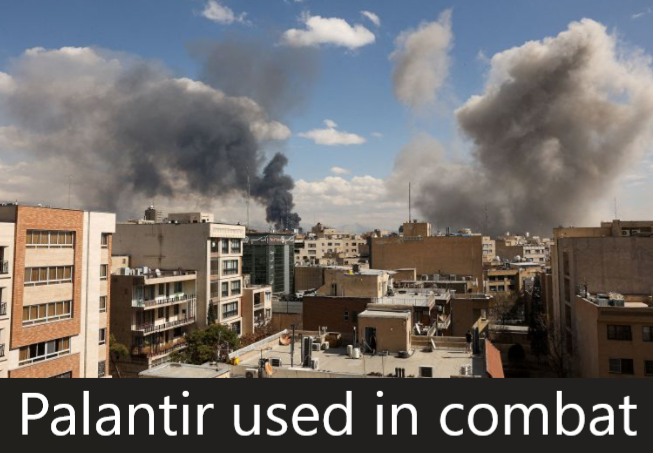
Reports in recent years suggest that A.I. tools have been used in various Middle Eastern operations. In discussions about Iran, analysts have suggested that systems like the Maven Smart System could help military planners process information rapidly. These tools can analyze satellite imagery, communications signals, and battlefield reports simultaneously. By integrating many streams of information, A.I. can highlight patterns that humans might miss. The technology can dramatically speed up the process of identifying military targets. Advocates argue that this speed could make operations more precise. Faster analysis could theoretically reduce mistakes and collateral damage. However, critics worry that the same speed might encourage faster military escalation. When decisions are accelerated, human oversight may become more difficult. The role of AI in these systems therefore raises serious questions.
One of the greatest concerns about artificial intelligence in warfare is the potential scale of destruction it could enable. AI systems excel at pattern recognition and optimization. As these systems improve, they may become increasingly efficient at identifying human targets or military assets. The danger lies not only in accuracy, but also in speed and scale. An A.I. assisted system might analyze thousands of potential targets in minutes. Historically, when new technology dramatically increases the efficiency of killing, the results can be devastating. A well-known example occurred during World War I. Military commanders initially used tactics based on earlier wars. Soldiers attacked in mass formations across open ground. These tactics collided with modern machine guns and heavy artillery. The result was unimaginable death and destruction.
Because of these risks, many experts argue that the international community should establish clearer rules governing military A.I. Existing laws of war already place limits on certain weapons and tactics. Agreements such as the Geneva Conventions define protections for civilians and prisoners of war. The Hague Conventions also established rules regarding weapons and battlefield conduct. Some experts believe that AI-enabled targeting systems should be addressed within similar frameworks. International agreements could require meaningful human oversight in lethal decisions. They could also limit fully autonomous weapons systems. Another possibility would be transparency requirements regarding military A.I. use. Such measures might help prevent an arms race in autonomous warfare. As artificial intelligence continues to advance, the debate over its role in combat will likely intensify. The choices made today could shape the future of warfare for decades to come.

Flux Korvin
CyborgNews